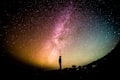
The observable universe contains over 2 trillion galaxies, each with hundreds of billions of stars. Yet all the matter we can see makes up only 5% of what exists.

The rest? Dark matter and dark energy—mysterious forces that shape the cosmos but remain invisible to us.

Strange Phenomena

Black hole bending light and spacetime

Black Holes

Regions of spacetime where gravity is so extreme that nothing—not even light—can escape. The boundary is called the event horizon, a point of no return.
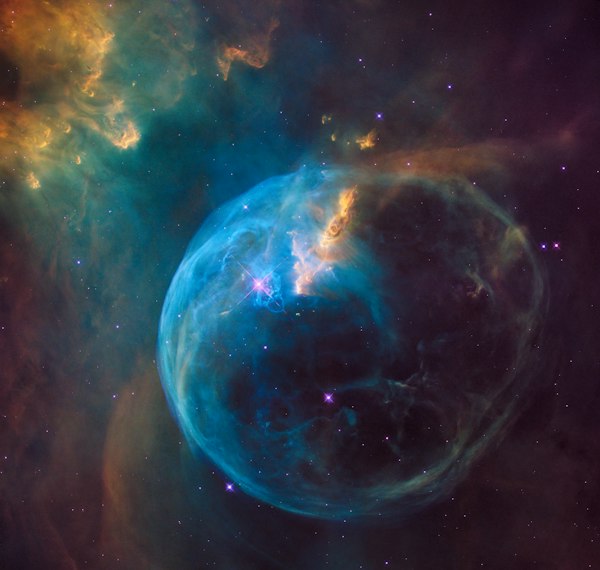
Supernova remnant nebula from a collapsed star

Neutron Stars

The collapsed cores of massive stars, so dense that a teaspoon would weigh 6 billion tons. Some spin hundreds of times per second.
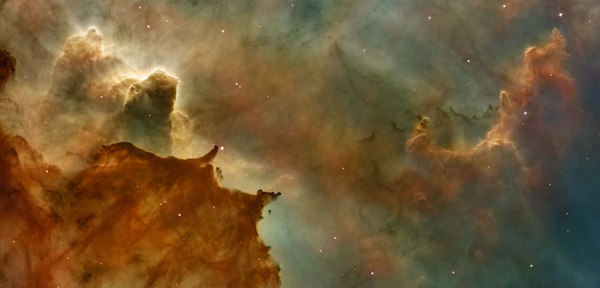
Brilliant quasar at the heart of a galaxy

Quasars

Supermassive black holes actively consuming matter, outshining entire galaxies. The brightest objects in the universe.
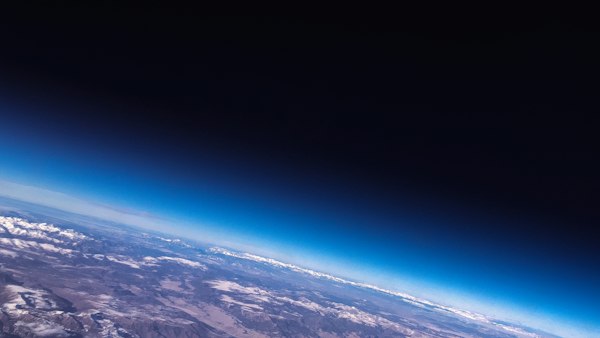
Intense cosmic energy burst from deep space

Gamma-Ray Bursts

The most energetic events since the Big Bang. In seconds, they release more energy than the Sun will in its entire lifetime.
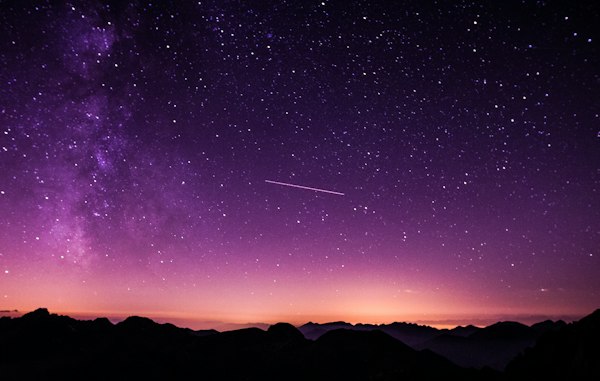
Galaxy clusters held together by invisible dark matter

Dark Matter

An invisible substance that doesn't emit light but exerts gravitational force. It holds galaxies together and makes up 27% of the universe.
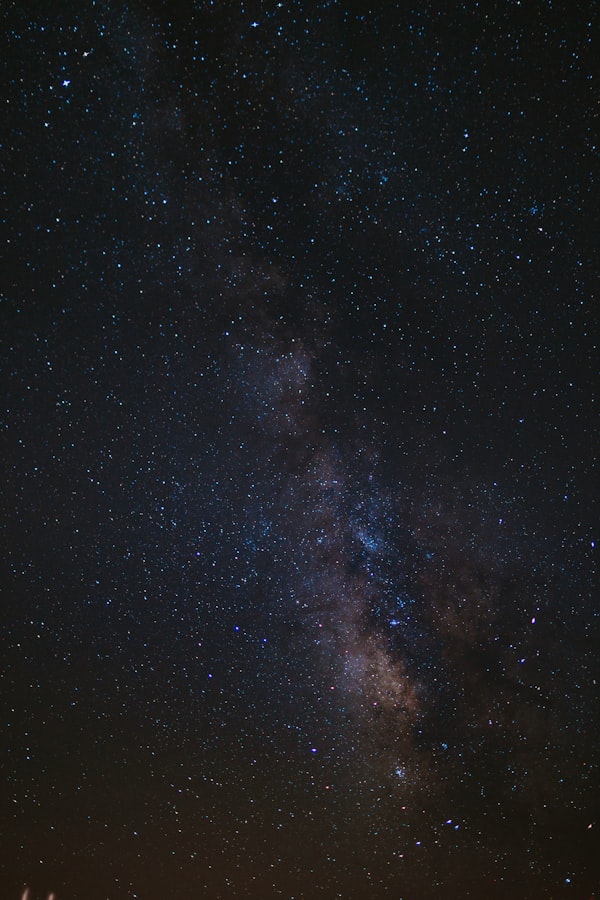
Distant galaxies receding in an expanding universe

Dark Energy

A mysterious force causing the universe's expansion to accelerate. It comprises 68% of the universe and remains one of science's greatest puzzles.
Mind-Bending Numbers

93 billion
Light-years across (observable universe)
2 trillion+
Galaxies in the observable universe
10²⁴
Stars in the observable universe
13.8 billion
Years since the Big Bang

The Big Bang

0 seconds

The Singularity

All matter, energy, space, and time emerge from an infinitely dense point. Physics as we know it breaks down.

10⁻⁴³ seconds

Planck Epoch Ends

The universe is smaller than a proton. Gravity separates from other forces.

10⁻³² seconds

Cosmic Inflation

The universe expands exponentially, growing from smaller than an atom to larger than a galaxy in a fraction of a second.

3 minutes

Nucleosynthesis

Protons and neutrons combine to form the first atomic nuclei: hydrogen, helium, and traces of lithium.

380,000 years

Recombination

The universe cools enough for electrons to bind to nuclei. Light can finally travel freely—we see this as the Cosmic Microwave Background.

400 million years

First Stars

Gravity pulls hydrogen clouds together to ignite the first stars, ending the cosmic dark ages.

13.8 billion years

Today

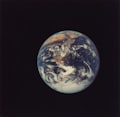
The universe continues to expand and cool. On a small blue planet, curious beings wonder how it all began.

Unsolved Mysteries

Cosmic web of dark matter

What is Dark Matter?

We know it exists from its gravitational effects, but we've never detected it directly. Particle accelerators search for candidates.

Particle symmetry and annihilation

Why More Matter Than Antimatter?

The Big Bang should have created equal amounts of both, which would have annihilated each other. Why does matter exist at all?

The primordial cosmos before the Big Bang

What Came Before the Big Bang?

Was there a "before"? Some theories suggest our universe emerged from the collision of higher-dimensional membranes.

Earth alone in the vast cosmos

Are We Alone?

With hundreds of billions of galaxies, each with hundreds of billions of stars, are we the only intelligent life? The Fermi Paradox haunts us.

"
The universe is not only queerer than we suppose, but queerer than we can suppose.
— J.B.S. Haldane

News & Discoveries

The latest from the cosmic frontier.

Continue Journey